
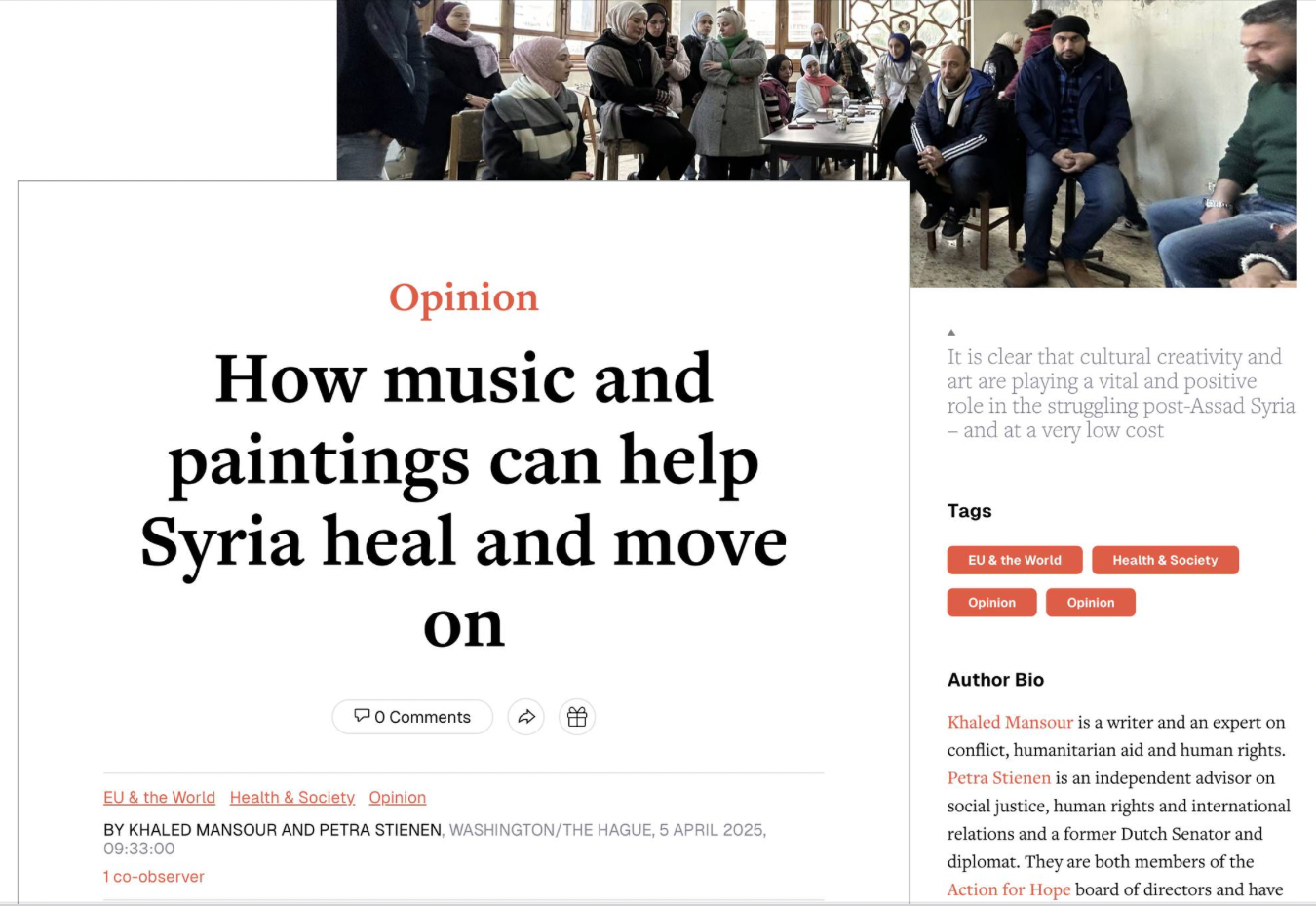
Published 5 April 2025 in the EU Observer and co-authored with Petra Stienen
“In the trash-strewn zigzagging streets of Al Husseiniya, a slum less than 15km south of Damascus, Ahmad Bakr walks with his Oud strung on his shoulder on his way to a small apartment where he runs a music school.
Al Husseiniya is a teeming area with tens of thousands of largely poor people. Many are Palestinian and Syrian refugees, pushed from their homes in waves since Israel was established in 1948, others were attracted by cheaper accommodation or had to flee merciless attacks by the murderous fallen Assad regime over the last 14 years
At one stage the school of Ahmad Bakr had about 50 students each paying a monthly subscription of 40,000 Syrian pounds [€2.78]. This rare music centre continued until 2024 when Bakr had to take a full-time job to pay the bills. He could not make a decent living only from the school where the fees barely paid for the rent and his basic needs.
Some of the students he taught are now working as music teachers and musicians and are willing to collaborate with him to restart the school. What used to be once a loathed activity is now more socially accepted, if not welcomed.
Bakr is not alone. Over two weeks in February, we travelled in Syria to meet with many similar artists and cultural initiatives as part of a team from Action for Hope, a not-for-profit cultural aid organisation that focuses on marginalised communities in conflict areas. The initiatives we visited invariably showed us how to create hope amid despair via artistic expression.
One meeting after another, one story after the other, it was clear that cultural creativity and art are playing a vital and positive role in the struggling post-Assad Syria — and at a very low cost.
They are helping people to overcome extreme pressures as well as contributing to the gigantic task of reconciliation in a country that has been systemically and sadistically tortured and torn apart along ethnic, sectarian, regional and class lines and left to rot in poverty by the Assad ruling cabal and by the world for decades.
People can heal and avoid the recurrence of atrocities by remembering and regarding the pain of others in an empathetic manner. That was very clear for us in Sweida and in Hama.
For Raid and his colleagues, part of the diminishing Christian community in Hama, they want to work as hard as they can to stay part of the city’s social fabric, to support a culture of citizenship in which they can be treated equally by all others and not a minority afforded protection by central repressive authorities such as the Assads did in exchange for relinquishing political rights.
It is in imagining new ways of life and slowly healing old wounds that hope is borne. And in this art helps a lot.
The team met with artists and artisans from over 30 organisations and initiatives. They could not have continued without a deep commitment to voluntarism and a strong sense of public service, as well as the hope and pleasure art creates. They now need support to continue and expand.
Most cultural initiatives in Syria rely on a voluntary spirit and operate on very small budgets but are nevertheless highly regarded and have exceptionally good reach within their communities. To expand and have more impact these organisations need financial and in-kind support.
EU can help
In Brussels last month, at the conference on Standing with Syria: Meeting the Needs for a Successful Transition over €6bn were pledged. All participants underscored the importance of an inclusive, Syrian-led transition grounded in human rights and international law.
We believe this can be better achieved, and at a relatively minimal cost, by paying more attention to cultural initiatives and folding them into the recovery plans for Syria.
It is hopeful to see that the co-chairs of this conference, EU foreign affairs chief Kaja Kallas and commissioners Dubravka Šuica and Hadja Lahbib, join Syria’s transitional foreign minister Asaad Al-Shaibani to express support for a follow-up event with the Syrian civil society this year.
This coming gathering should look into how best to support cultural organisations and artists and to rehabilitate the decimated infrastructure they all need — for example, the public cultural centres that exist all around Syria and provide a free space for performance and exhibitions, but of them need rehabilitation and some basic running cost.
By investing in culture and creative expression, the international community can enable Syrians to rebuild trust, work on social cohesion, and restore a shared national identity after decades of dictatorship and conflict.
And it would really help materialise the aspirational words of commissioner Lahbib at the Brussels conference: “all together for a brighter future for Syria”.
the link in comment (you need a free registration with email).
